From our instructors
What You Actually Need to Start Flight Training
New students usually arrive having bought either nothing or everything. Both are expensive mistakes. This is the list we give our own students, in the order you will actually need things, with honest guidance about what is worth spending money on and what is not.
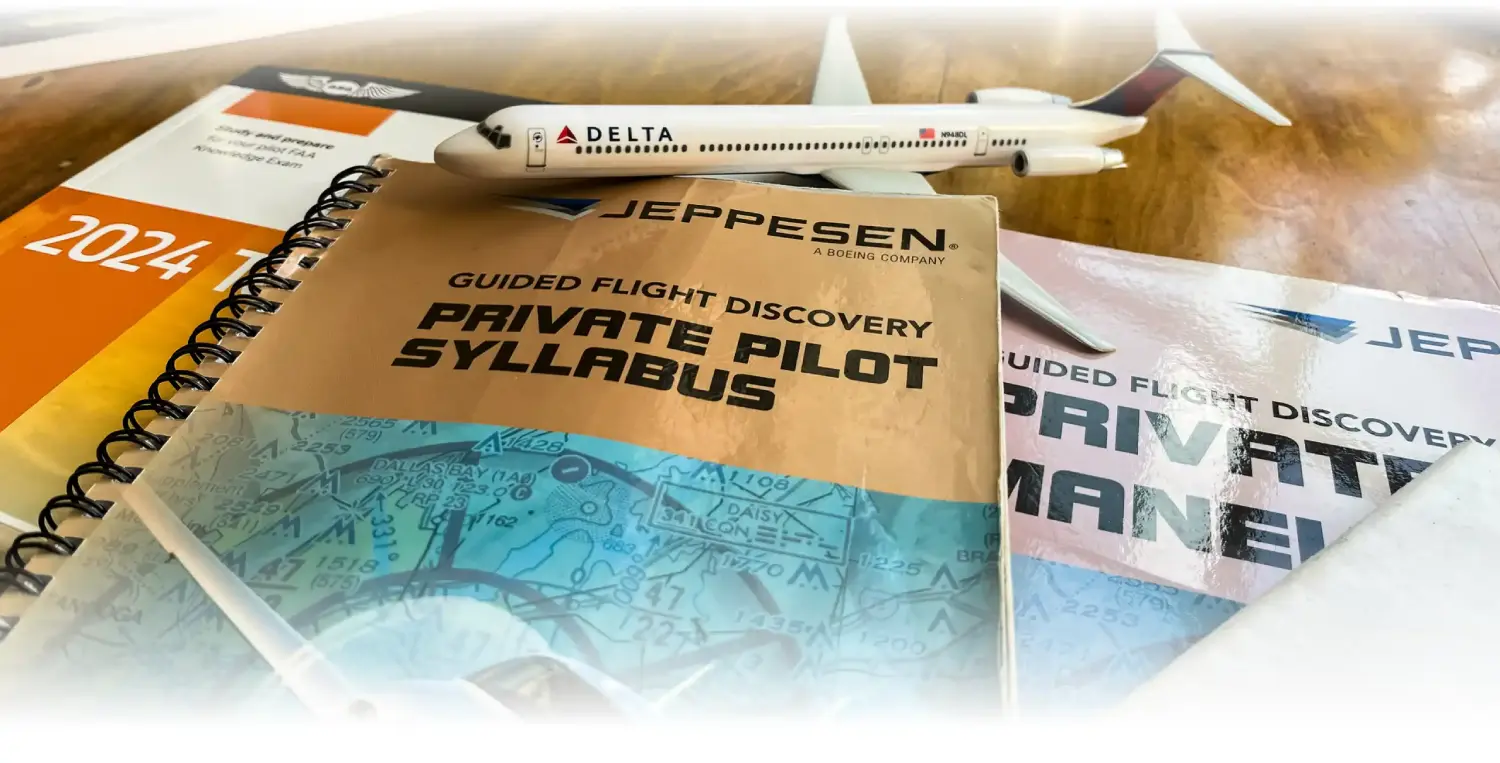
On the SUNY Schenectady pathway? The bookstore flight kit covers most of the books — the Jeppesen syllabus, Guided Discovery, Maneuvers Manual and Test Guide, plus the ACS, a FAR/AIM, an E6B and a plotter. It does not include a headset. Once you are past the books, our flight planning resources page has the charts, weather links and safety procedures you will use every lesson.
Stage 1
Buy Before Your First Lesson
A headset
The one thing to buy before you start. $150–400 is fine to begin with; upgrade to active noise reduction later, when you know you are continuing. Your hearing does not grow back.
More detail
The most affordable headsets can go for anywhere from $150–400. These will be sufficient for the brand-new private student. In the long term, we recommend purchasing a more expensive headset with Active Noise Reduction (ANR). These are not only more comfortable, but will also help protect your long-term hearing — which is very important when working with loud airplanes!
The Jeppesen Private Pilot syllabus and Guided Discovery
Reading ahead is the cheapest thing you will ever do in aviation — ground knowledge learned at home is knowledge you are not paying $265 an hour to learn in the aircraft.
More detail
The syllabus outlines your training. It establishes what is covered in each lesson, including knowledge and maneuvers. Students should refer to this syllabus prior to each flight and familiarize themselves with the content of each lesson. Any subjects being introduced should be studied by the student. This will reduce lesson time on the ground and in the air, ensuring a faster course of training and reducing student spending.
The Jeppesen Guided Discovery book is designed to introduce a pilot to all ground knowledge topics covered by flight training. Students are encouraged to read each chapter applicable to their next lesson to ensure a sound understanding of fundamental concepts pertaining to aviation.
Example: the syllabus states that after Flight Lesson 2, the student should study Ground Lesson 4: “The Flight Environment”. Ground Lesson 4 in the syllabus will advise the student to read Chapter 4 Sections A–D in the Guided Discovery book.
Stage 2
Buy in Your First Few Weeks
FAR/AIM
You need a working understanding of Parts 43, 61, 67, 68 and 91, and a current copy is required for your private checkride.
More detail
The FAR/AIM is an FAA-published book consisting of the Federal Aviation Regulations found in 14 CFR, and the Aeronautical Information Manual. Students are required to have a basic understanding of applicable regulations found in Part 43, Part 61, Part 67 & 68, and Part 91, and should be familiar with the Information Manual. A current copy of the FAR/AIM is required to take the Private Checkride.
Airman Certification Standards
Every task and standard you will be tested on. A digital copy is fine for training; bring a printed one to the checkride.
More detail
The ACS provides an outline of all tasks which must be covered during your checkride, and standards that must be met. While a digital copy of the ACS is sufficient reference for flight training, we encourage students to have a physical copy of the booklet in hand during their checkride.
E6B flight computer
Required for cross-country planning. Paper whiz wheel or electronic, but note that you cannot use a phone app during the knowledge test.
More detail
The E6B is required for cross-country flight planning. It can be either a paper “whiz wheel” or a digital calculator. While some E6Bs can be downloaded onto your phone, your phone cannot be used while taking the knowledge test.
Jeppesen Maneuvers Manual and Test Guide
Step-by-step maneuvers and several hundred practice questions. Work the test guide until you consistently get answers right and know why.
More detail
The maneuvers manual provides step-by-step instructions on how to perform each maneuver taught in flight training, as well as skills students will obtain from each maneuver. Students who study the maneuvers listed in the syllabus prior to each flight lesson will spend less time on the ground and in the air learning the maneuvers, reducing time spent in each lesson and lowering the cost of training.
The test guide provides a bank of hundreds of questions similar to what you’ll see when you take the FAA Knowledge Test. Continuous self-quizzing of the questions in the book until you’re consistently answering all questions right (while understanding why they’re right) is the best way to study for the written.
Stage 3
Wait Until Your Instructor Tells You
Sectional chart
Around $20, and it expires every 56 days. Do not buy one until you reach Stage II, or you will simply throw it away.
More detail
Sectional charts can be purchased for the New York region for around $20 online. As these expire every 56 days, we advise students not to purchase them until Stage II. A current sectional chart is required for cross-country training and the checkride.
Plotter
Buy alongside the sectional; you will use them together.
More detail
A plotter is used on a sectional chart to draw courses, measure distances and determine true course. It will be used alongside the sectional chart and E6B for cross-country training.
View-limiting device (a hood or foggles)
Around $20, needed for the three hours of simulated instrument time in the private course and for unusual attitude recovery on the checkride.
More detail
A VLD can come in the form of a “hood” or “foggles”. These will be required for instrument training as well as for 3 hours of simulated instrument training in the private course. Private students will also have to demonstrate unusual attitude recovery during the checkride, which will require a VLD. Both foggles and hoods can be purchased for around $20 online.
Pilot Information Manual
Wait for guidance. A PIM is issued by the manufacturer for a range of serial numbers and is not the same as an aircraft-specific POH or AFM, so a student flying N16446 needs a different PIM from one flying N8092N, even though both are PA-28-140s. Buying the wrong one is a common and avoidable mistake.
More detail
A PIM can be thought of as your airplane’s owner’s manual. It provides information on normal and emergency procedures, airspeed and weight and balance limits, and expected aircraft performance. This will be required for cross-country training. Note that a PIM is not the airplane’s specific Pilot Operating Handbook (POH) or Airplane Flight Manual (AFM). The POH or AFM is specific to each individual airplane, while the PIM is provided by the manufacturer for a range of airplanes depending on serial numbers.
Next ratings
For Instrument and Commercial Students
One combined set of Jeppesen books
Jeppesen publishes Instrument and Commercial as one combined syllabus, so you only need one set of books — syllabus, Maneuvers Manual, Guided Discovery and Test Guide.
An electronic flight bag
Use an iPad or tablet, not a phone: the screen is too small for approach plates, and you want a backup that will not overheat or die mid-approach. ForeFlight and FltPlan Go both work well.
More detail
Now that you’ve graduated the Private course, it’s time to move on to more modern equipment. EFBs provide a place to store and review documents in-flight, and can be used for flight planning and navigation. Most pilots use a standard iPad or tablet. Students should not rely on their phone as an EFB due to the small screen and lack of backup in case of failure (overheating, battery depletion and so on).
A yoke mount
Strongly recommended for instrument training — you will be reading approach plates and briefing while hand-flying, and holding a tablet is not a plan.
Two separate ACS books
Instrument and commercial are tested against two different standards.
Ask before you buy
Questions About Any of This?
Ask before you buy. A five-minute phone call has saved plenty of our students a few hundred dollars on equipment they did not need yet.
We will recommend customized materials for you that are readily available from sportys.com and aircraftspruce.com.