
14 CFR 141.93(a)(3)
KSCH Safety Procedures and Practices
The safety procedures and practices developed by the school that describe the use of the school’s facilities and the operation of its aircraft at Schenectady County Airport.
This page reproduces the operating sections of our Safety Procedures and Practices Manual for quick reference. The signed manual is the controlling document — download the full manual (PDF, Revision 6). It is not intended to be a replacement for common sense or any applicable FAA rules and regulations.
1.0General Rules and Procedures
This manual was developed by Five Star Flight and is designed to meet the requirements of FAR Part 141.93(3)(i) through (x). This manual is to be used as a general policy and procedures manual for the safe operation in and around the Schenectady County Airport and the Five Star Flight (FSF) facility.
- All student pilots must receive approval for solo flights from a qualified instructor who is on the airport (14 CFR 141.79(b)).
- A preflight inspection must be performed before each flight.
- All frost, snow and ice must be removed from all aircraft surfaces, windows and windshield before flight.
- All flights must be conducted in accordance with all school, local and FAA regulations and procedures.
- Acrobatic maneuvers are prohibited.
2.0Use of the School’s Facilities
2.1 Restricted areas
For safety and insurance purposes, the Schenectady Control Tower is not to be entered at any time without previous consent of the control tower personnel. These areas are to be entered by authorized personnel only.
2.2 Access to the ramp
At 8 Tower Road, access to the ramp area and/or hangar space is to be gained only by way of the walk-through doors on the Tower Road side of the hangar. The most south door is the primary access to the classroom and remaining hangars. At no time should students utilize a drive-through gate unless accompanied by a Five Star flight instructor.
3.0Weather Minimums for Flight Training
3.1 Flight operations weather minimums — ceiling and visibility
| Flight | Traffic pattern | Local day | Local night | X-C day | X-C night |
|---|---|---|---|---|---|
| Dual VFR | 1,500 ft3 miles vis | The required visibility and cloud clearance required by the airspace in which the flight is to take place, as per 14 CFR 91. | |||
| Student solo | 1,500 ft3 miles vis | 3,000 ft5 miles vis | N/A | 5,000 ft5 miles vis | N/A |
| Dual IFR | N/A | Lowest applicable Cat I minimums for the appropriate instrument approach procedure to be used. | |||
Instructors may, at their discretion, file and fly under an IFR flight plan to another approved airport for the purpose of avoiding a local weather phenomenon and reaching the required VFR weather minimums to conduct a VFR lesson. For IFR training in actual conditions, see applicable FAR Part 91 weather minimums for IFR flight.
3.2 Maximum wind limitations
- Dual — not to exceed the applicable aircraft operating limitations.
- Solo — not to exceed 20 knots total head wind and/or 10 knots cross wind component. This limitation includes the gust. Individual instructors may impose more restrictive limitations on individual students, considering safety of flight and abilities of students.
3.3 Minimum altitude limitations
The minimum altitude for local training is 2,000′ AGL for all maneuvers except ground reference maneuvers, which should be performed between 600′ AGL and 1,000′ AGL. Simulated engine failures may, under the discretion of the flight instructor, be performed down to 500′ AGL over sparsely populated areas. Care must be used when performing simulated engine failures to occasionally “clear” the engine with the throttle to make sure the engine is still running properly and shock cooling does not occur. Care should also be taken to avoid rapid throttle movements.
A gradual reduction of power should be used when decreasing airspeed or beginning a descent. Decreasing power in increments of 100 rpm (or one inch in a complex aircraft) every 7–10 seconds will help to avoid shock cooling the engine. This is particularly important during the cold winter months.
Simulated engine failures at night are allowed in the traffic pattern only. Student pilots must ensure that all necessary lights, more specifically navigation lights and landing lights, are utilized for night operations and night landings.
5.0Engine Starting and Taxiing Procedures
Aircraft pre-heater
Only instructors and/or line personnel should utilize the propane pre-heater. Follow pre-heat instructions carefully and never pre-heat an aircraft inside the hangar. Personnel must remain within 20 feet while the pre-heater is running. Never leave the pre-heater unattended while in operation. Do not use the propane-powered heater to heat the cabin or cabin electronics. The propane regulator should be at 25 psi and a maximum of 30 psi (higher psi will cause a fire). In the event of overheating or fire, shut off the propane tank first.
On the ramp
The ramp is a potentially hazardous area and safety must be exercised when conducting activities in this area. Aircraft taxiing, maintenance and fueling, truck operation and pilot movement may make the ramp extremely busy at any given time. Only authorized personnel, customers and their passengers are allowed on the ramp. Due to the fact that airport ramps are noisy and a spinning propeller is difficult to see, the aircraft’s beacon shall be on anytime the engine is running. Permission to taxi must be obtained from the tower prior to exiting the ramp. Taxi speeds shall be that of a fast walk.
Extra care shall be taken when exiting the hangar ramp and taxiing through the “pass through” between the two hangars to the main ramp. All pilots should announce taxiing through this area on 123.45 and exercise extreme caution when entering or exiting through this “pass through” area.
Starting
Checklists shall be used for all preflight and engine start procedures. Care should be taken before engaging the starter to be sure there are no persons near the aircraft. A verbal yell out the window such as “clear” shall be used before engaging the starter. The pilots and/or passengers are not allowed to board or deplane while an engine is running. A qualified pilot shall be at the aircraft controls at all times the engines are running.
6.0Fire Precautions and Procedures
6.1 Servicing
To help prevent the risk of fire during aircraft servicing, the aircraft engine must be shut down with the magnetos and master switches off. The aircraft must be chocked prior to servicing. When available, aircraft should be serviced by an authorized aircraft servicing technician.
When servicing from a self-serve fueling station the following steps should be used:
- Determine what fuel grade is required for your aircraft
- Determine how much fuel is required
- Connect the ground wire to the aircraft, usually on the exhaust pipe
- If needed, put the ladder in front of the fuel cap on the furthest fuel tank
- Drag out the fuel hose for as far as you need it
- Remove the fuel cap
- After fueling, reinstall the fuel cap
- Wind up the fuel hose
- Disconnect and wind up the ground wire
- Double check the fuel caps are secure
6.2 During start
To help avoid engine fires during start, do not prime a hot engine.
Should an engine fire occur on the ground during start:
- Continue to crank the engine
- Immediately retard the throttle to idle
- Pull the mixture control to idle cut-off (full lean)
- Move the fuel selector to the “off” position
- Crank the engine until fire is no longer indicated or the starter fails
- Turn the master switch to the “off” position
- Exit the aircraft and move to a safe distance
6.3 On the ground
Should an engine or aircraft fire occur on the ground but not during start:
- Immediately retard the throttle to idle
- Pull the mixture control to idle cut-off (full lean)
- Move the fuel selector to the “off” position
- Place the master switch in the “off” position
- Exit the aircraft and move to a safe distance
Note: if fire occurred on an active ramp, taxiway or runway, be vigilant of other aircraft while walking to a safe distance. Also, if at a tower-controlled airport, do not attempt to walk back to the terminal. Wait for airport personnel to assist.
6.4 In flight
Fires in flight are rare. However, should this occur, it is important to quickly assess your situation with respect to getting the aircraft on the ground as soon as feasible.
- Immediately pick a place to land.
- Retard the throttle to idle and establish best glide airspeed. If altitude permits and the fire is outside the cockpit, higher than best glide airspeed can be used to help put out the fire.
- If time permits, make a mayday call.
- Turn the master switch off.
- If smoke is in the cockpit, open a window and all fresh air vents. This will help evacuate the smoke for improved visibility and rid the cockpit of any toxic fumes.
After the landing is assured:
- Pull the mixture control to idle cut-off (full lean)
- Move the fuel selector to “off”
- Use emergency landing technique as outlined in the aircraft’s AOM
Note: the safety of people supersedes any thought of preserving the aircraft.
7.0Re-dispatch Procedures After Unplanned Landings
The following steps need to be followed if you land at airports or locations other than those listed on your logbook endorsement.
7.1 Landing at an airport that is not listed on the logbook endorsement
- Contact the school and inform us of the reason for the unplanned landing.
- A flight instructor will need to issue re-dispatch instructions and send via fax a new endorsement before resuming flight for all student pilots.
- If you hold at least a private pilot certificate, you can resume flight after notifying the school of the unplanned landing, assuming there was no emergency that necessitated the unplanned landing.
7.2 Landing off airport
- The flight shall be terminated; do not make an attempt to take off from an unimproved location.
- Secure the aircraft as best as the situation allows and contact the school for further instructions.
In cases of mechanical or medical emergencies
- Once your safety and the safety of your passengers is ensured, secure the aircraft as best as the situation allows and contact the school for further instructions.
- Terminate the flight and do not attempt further flight.
8.0Aircraft Discrepancies
- Aircraft discrepancies must be verbally reported to the maintenance coordinator as soon as possible. If the maintenance coordinator is not available, contact the agent of service.
- Discrepancies observed during preflight should be reported before leaving the ramp.
- Discrepancies during flight should be reported at the termination of the flight.
- If a serious discrepancy develops during a local flight, return to the base airport immediately and report to the maintenance coordinator.
- If a serious discrepancy develops during a cross-country flight, immediately land at the nearest airport you can safely navigate to and call the maintenance coordinator.
No pilot will attempt to fly an airplane with a maintenance discrepancy unless it is repaired and returned to service by an authorized A&P mechanic, or it is established to be non-essential and placarded and rendered inoperable under the approval of said A&P mechanic and FSF management. Dispatch, maintenance and return-to-service procedures (sections 4.0 and 9.0) are in the full manual.
10.0Securing of Aircraft When Not in Use
At the termination of a flight, always secure the aircraft in accordance with the aircraft’s checklist. After each flight the aircraft should be properly chocked and tied down in one of the designated tie-down spots for Five Star Flight or in Five Star’s hangar space at the KSCH airport. Also after each flight, the control lock must be installed and the doors must be locked. Care should be taken to ensure the seatbelts are inside the aircraft before the doors are closed. As a courtesy to the next pilot, please clean out any personal items you may have brought with you on the flight.
If the aircraft is to be left unattended at an airport other than KSCH, the aircraft should be properly chocked and tied down (if available), the control lock must be installed and the doors must be locked.
11.0Fuel Reserves
All local and cross-country flights must be planned so as to be able to complete the flight with one hour of fuel reserve remaining.
12.0Avoidance of Other Aircraft
Pilots must maintain continuous traffic surveillance both in flight and on the ground. A “see and avoid” technique shall be practiced both in flight and on the ground.
12.1 On the ground
The ramp at the base of the KSCH Control Tower and the ramp at the North End hangar are considered non-movement areas, so the KSCH control tower does not control this area. In an effort to avoid a conflict with aircraft taxiing inbound to the ramp, always monitor ground control and make a visual check before taxiing away from the tie-down. Whenever the tower is in operation, obtain taxi clearance before attempting to leave the ramp.
12.2 In flight
In flight, comply with FAA established right-of-way rules and always monitor the tower frequency when in and around the practice area. Clearing turns should be performed before initiating flight maneuvers to ensure the area is free of conflicting traffic. Utilize 122.75 in the Schenectady Northwest practice area for air-to-air communications. Albany Approach/Departure (132.82) may be contacted for additional separation assistance, as needed.
Pilots are encouraged to monitor the appropriate communication frequencies for traffic activity at non-towered airports.
13.0Minimum Altitude Limitations and Simulated Emergency Landings
Simulated engine failures may, under the discretion of the flight instructor, be performed down to 500′ AGL over sparsely populated areas. Care must be used when performing simulated engine failures to occasionally “clear” the engine with the throttle to make sure the engine is still running properly and shock cooling does not occur. Care should also be taken to avoid rapid throttle movements. A gradual reduction of power should be used when decreasing airspeed or beginning a descent. Decreasing power in increments of 100 rpm (or one inch in a complex aircraft) every 7–10 seconds will help to avoid shock cooling the engine. This is particularly important during the cold winter months.
Student pilots will not attempt simulated forced landings on solo flights. Flight below 500 feet AGL is not permitted except for takeoff and landing.
Simulated engine failures at night are allowed on dual flights in the traffic pattern only. Student pilots must ensure that all necessary lights, more specifically navigation lights and landing lights, are utilized for night operations and night landings.
14.0Use of the Practice Area
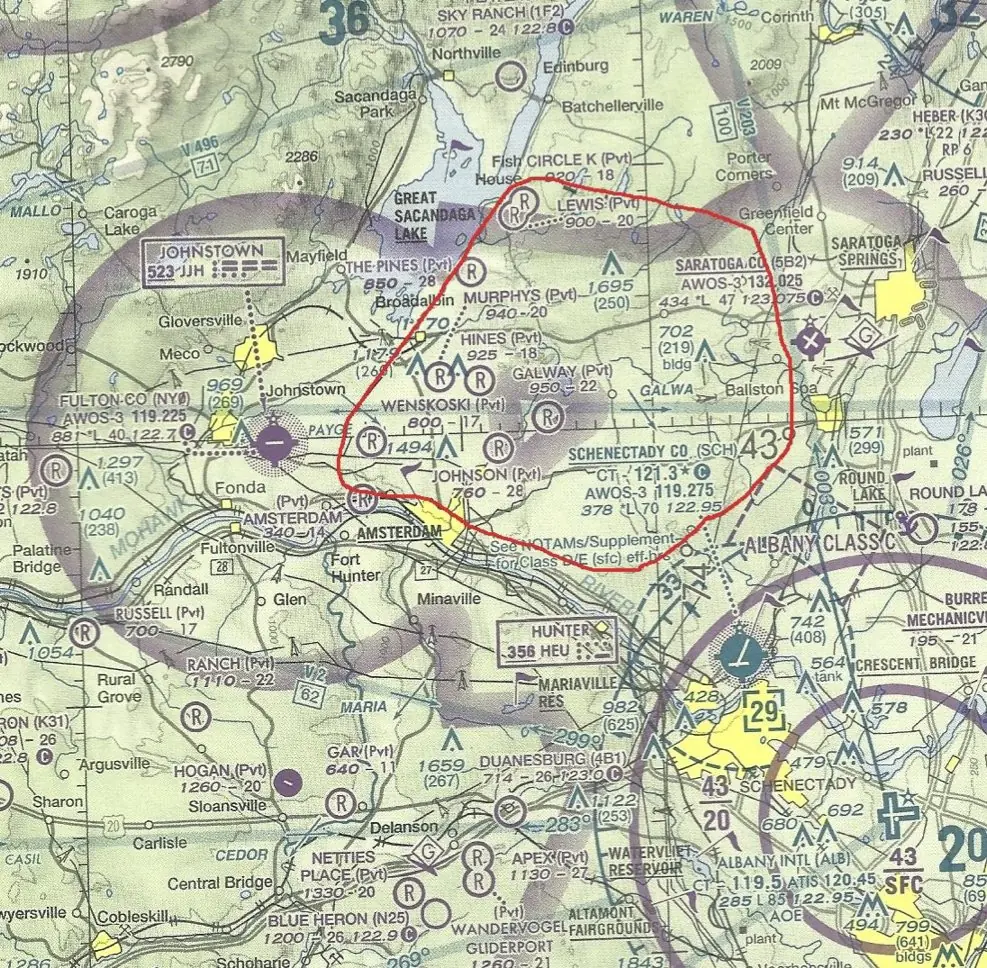
The practice area is located approximately 8 NM northwest of KSCH. This area has the following approximate boundaries: SW to NE powerlines which indicate lateral clearance of Albany Class C airspace, at and below 2,000 feet MSL; the Mohawk River to the WNW; the Sacandaga Reservoir to the north; Saratoga Airport (5B2) and Ballston Lake to the east and south.
Care and vigilance must be used when entering, exiting or using the practice area, as it is shared by other training centers. The area over Saratoga Airport is to be avoided as it is known to be busy with general aviation jet traffic in the summer months, and glider operations. This is especially true on the weekends. The minimum en route altitude to and from the practice area is 2,000 feet MSL.